A win-win for every partner
Schools, doctors, the diagnostic centre, the Foundation and families each give and gain.
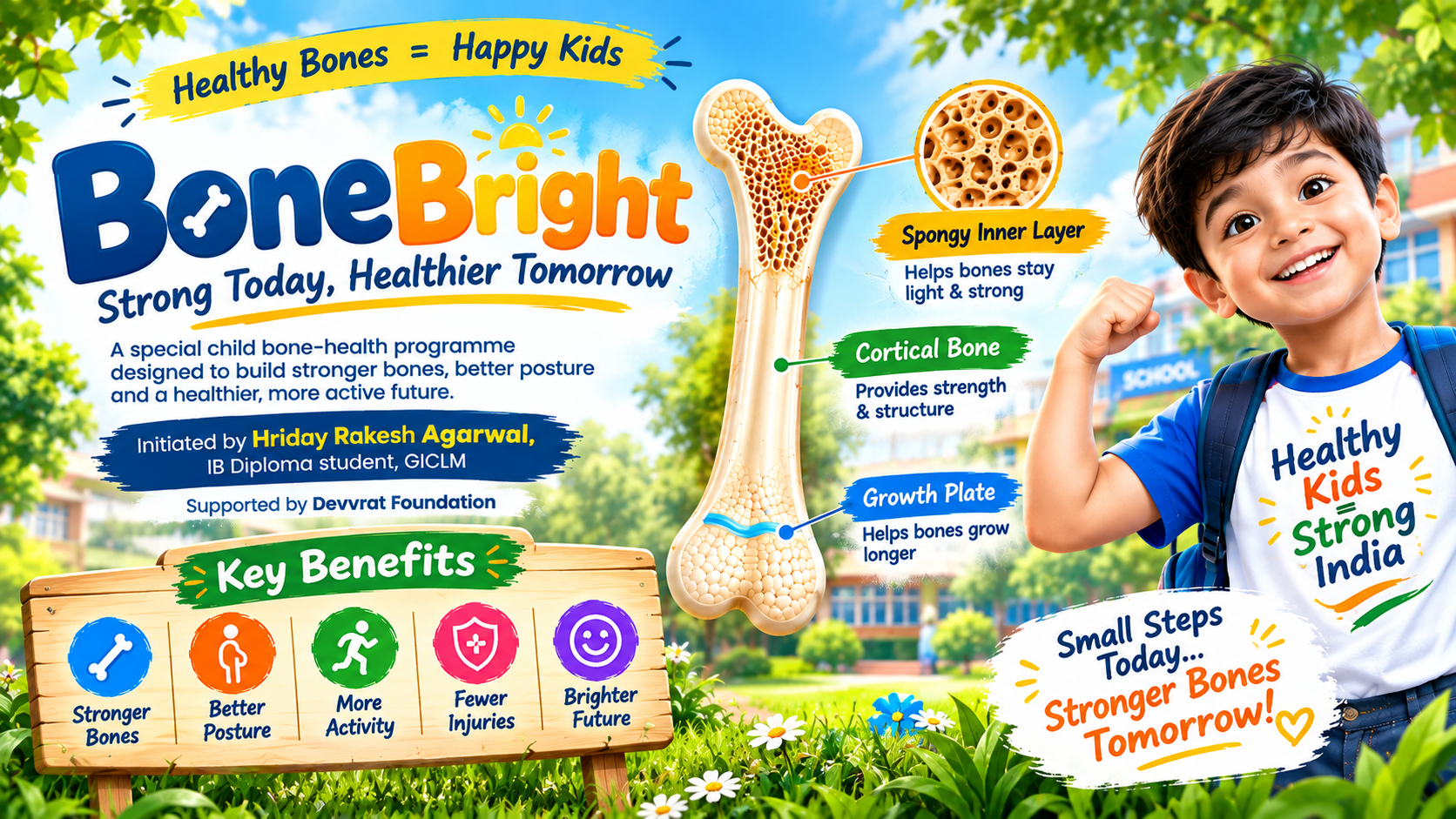
BoneBright is an awareness and early-screening programme that helps school children build stronger bones and discover problems early.
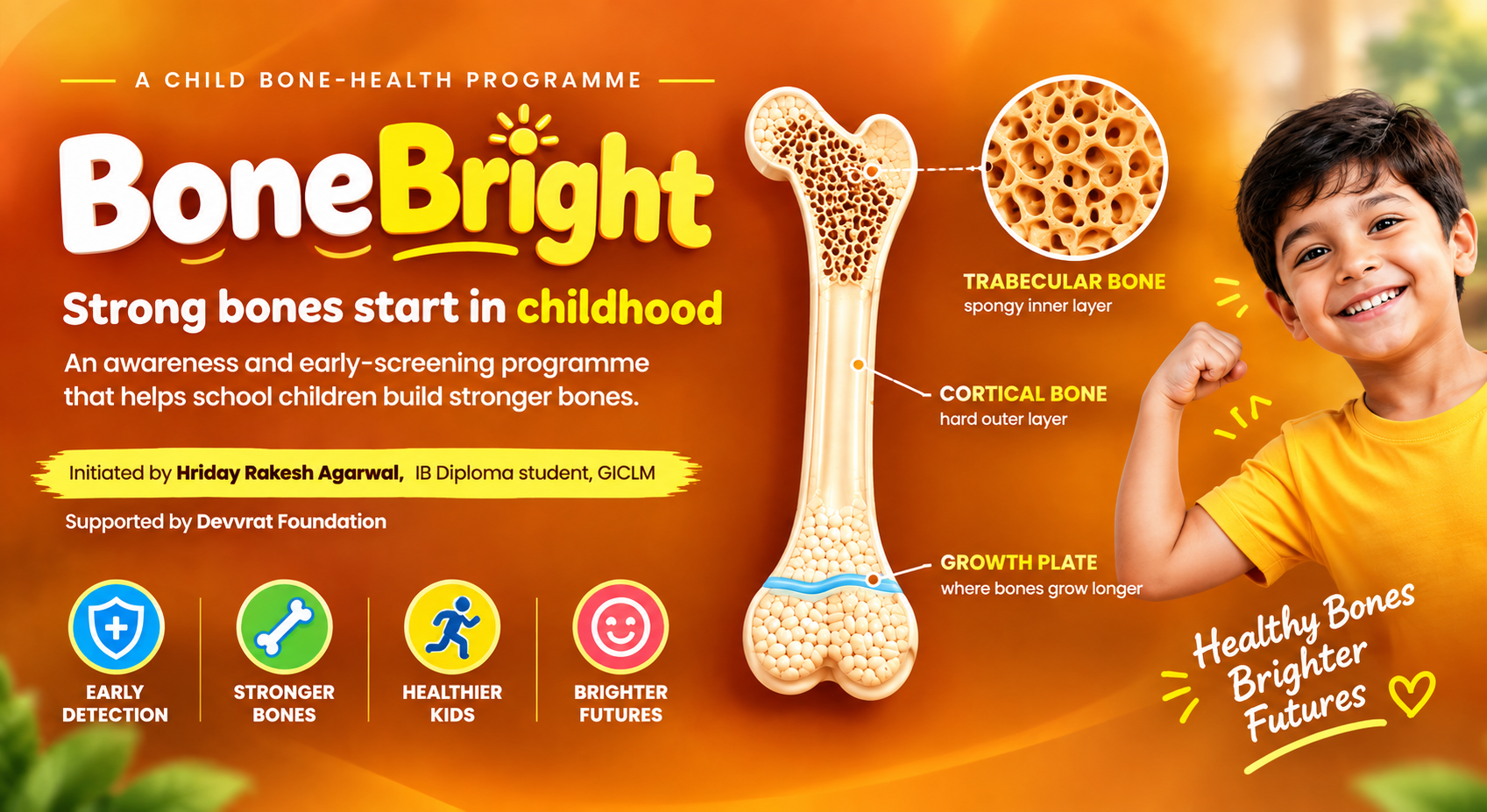
BoneBright helps school children build stronger bones through awareness talks and a simple check-up, so problems are found early, while bones are still growing.
students to be screened
simple health checks
school camp or diagnostic centre
October 2026 to January 2027
Schools, doctors, the diagnostic centre, the Foundation and families each give and gain.
Study the health of school children, with a main focus on bones.
See how height, weight, Vitamin D3, CBC and ESR relate to each other.
Look for any pattern by blood group, shared as an observation, not proof.
BoneBright helps school children build stronger bones through awareness talks and a simple check-up, so problems are found early, while bones are still growing.
It was started by Hriday Rakesh Agarwal, an IB Diploma student at GICLM who hopes to become an orthopaedic surgeon, as his CAS (Creativity, Activity, Service) project.
host the awareness talk and the check-up camp.
gives the talk and reviews every report.
collects samples and runs the tests.
pays part of the cost.
give consent and co-pay the rest.
Every step of BoneBright is designed with children's safety, privacy and consent at the centre.
A signed form for every child, and any child can say no.
Samples taken with sterile, single-use needles.
Shared only with parents and the paediatrician.
Code numbers, never names. Only group results are shared.
Children appear in materials only with permission.
Medical care stays with the doctor and the diagnostic centre.
BoneBright will help us understand the health of our students and make a real difference through simple, clear and meaningful data.
How common is low Vitamin D3 among our students?
How does Vitamin D3 vary with age, gender and BMI?
How many children show signs of anaemia on the CBC?
Is there any pattern by blood group?
Students screened, against a target of about 1,000
Share of consent forms returned
Children guided to follow-up care
Schools rated and findings shared